Friday, March 27, 2009

See the New Blog

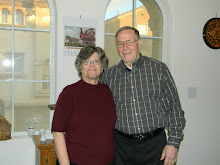
We have recently moved from Acworth, GA to Moncks Corner, SC , and I have chosen at the same time to change the title of my blog to "Comments from the corner." You can now find a somewhat more newsy blog at www.commentsfromthecorner.blogspot.com

A new name for a new location

Well, here we are, three weeks into our status as South Carolina citizens. We are now living in Moncks Corner, SC. If you'll e-mail me, I will be glad to send you our exact address.
Speaking of moving, our Bible reading yesterday was the introduction to the book of the Recapitulation of the Covenant (otherwise known as Deuteronomy). In this chapter, Moses gathers the people and prepares them for a reminder concerning what lies ahead by giving them an outline of their history since they left Egypt, and reminding them of God's sovereignty and their need for His guidance and protection.

The history points out how God has dealt toward them by showing His power in discrediting the gods of Egypt and bringing them out of their slavery. He brings them to Mount Sinai after miraculously opening up the Red Sea so that they can cross on dry land. He then tells Moses to make the preparations for entering the land of Canaan.

As I read this passage, I was surprised to see a detail which I had not seen before-- the idea of sending spies out to check out the land was not Moses' idea nor God's, but it came from the people. Another detail was that they all came back with a very good report.

So, how come they did not go right in and conquer the land immediately? It was a conflict of WILLS. It was GOD's will vs. Israel's will. Moses points out that "you were unwilling to go up: you rebelled against the command of the Lord your God." (Deut. 1:26) This was not an intellectual battle. They had seen God's work, so they knew He could do what He promised. They had seen the land, so they knew that the land was good. But there was another force at work here: There was a total lack of trust in God. Only two out of twelve were willing to trust His promises. Instead, the other ten led the chorus of "grumbling", an undercurrent of insinuations and detractions which questioned God's good will toward them. The result was that the people were discouraged (they lost heart), and a whole generation lost out on God's blessing. They saw enemies everywhere, but did not take into consideration the huge advantage they had by having God on their side. Nothing Moses could say was able to dissuade them. They were not about to trust. They could not see the truth of what Moses said "...God carried you, as a father carries his son, all the way you went until you reached this place." (1:31) When I read this verse, I was reminded of the poem which many of us have read, and which has brought tears to my eyes on more than one occasion-- "Footprints" describes in the form of a dream this very fact. When we can only see one pair of footprints in the sand, it is not because God has abandoned us, but rather because He has picked us up and carried us through a difficult situation.

As we enter this new phase, I pray that our precious Lord will make each of us aware of His daily presence in our lives, and that we will be willing to follow Him here in the Corner--not hiding away or grumbling, but valiantly forging ahead in the confidence that He is with us at all times, and will pick us up and carry us when the circumstances seem unbearable.

Have a wonderful day trusting Him, and depending on Him!!

Friday, March 20, 2009

Is God's Second Best Good Enough

Sears may have started it in the area of merchandising, but many other retailers have followed. They offer the GOOD, the BETTER and the BEST. Of course, when it comes to merchandise, we all want the BEST, and whether we get it depends on what we can afford.

But in the lives of the Israelites God was willing to give them the BEST. When Moses sent out the spies to look over the land, Joshua and Caleb came back telling of the prospects. They even had to enlist some help to carry the huge bunches of grapes they picked in the Promised Land. But Israel chose to be a "democratic" society and not listen to the two spies who were in tune with God's BEST. The majority ruled, and a landslide at that. After all, the prospect of going out to fight for a land that God had promised was not exactly exciting. Someone might actually get hurt!

So they chose the BETTER. Yes, it was better than being slaves in Egypt, though that was GOOD for almost 400 years. But the quality of life there had deteriorated as Egypt found that the Israelites were hard workers, and decided to get more and more out of them--production, production, production!

Now, because Israel chose not to forge ahead and achieve the BEST, all the men of military age at the time of the spies' report would not get to enter the Promised Land.

Almost forty years later, after camping out in the desert for most of that time, Israel was faced with the prospect of actually being allowed by God to enter the Land of Promise. Numbers 32 tells us that 2 1/2 tribes of Israel (Reuben, Gad and Manasseh) had decided for the BETTER, leaving the BEST to the other 9 1/2 tribes. When Moses tried to dissuade them from that plan, they would not reconsider. So Moses pointed out that the choice was not going to be that easy. The men of military age would still have to go across the Jordan and help the others conquer the land, but they would not be able to inherit the Promised Land. They would stay at the threshhold and achieve only the BETTER.

Normally we could not make these applications, but both Moses and the writer of the epistle to the Hebrews make the application, so we are more than justified in doing so. Many followers of Jesus Christ (which is GOOD) stop short of the BEST by choosing the BETTER. Rather than letting Him have all of themselves and the bountiful goods that He supplied them with in the first place, they choose to hang on to the BETTER and get into a daily routine of sameness--same job, same services attended, same niceties said to fellow workers, etc. Their theme--and I confess it is tempting to fall into this rut-- could be:

About evangelism: "I'll help pay the salary for a Minister of Outreach"
"That's what the pastor gets paid for."
"I'm not gifted in that area"
About missions: "I'll support our church's missionaries."
"I'll go do support work so that the missionaries can do the work they were called to."
" I can support a national for much less than it would cost to keep me on the
field, and he can do the job so much more efficiently."
"I'm a farmer--I can teach them to support themselves by farming."
About personal growth: "I am what I am--it's in my genes--there has been much improvement,
but I can't see where I can change who I am."

While many of these statements are true, they fail to take into consideration one factor: What is God's BEST for me? They also fail to take into consideration who it is that will effect the change in our lives and in the lives of those whom we touch. Our job is not so much to DO what God wants us to DO, as it is to BE who He wants us to be--the doing will be the result.

If you feel like I'm preaching at you, be aware that I'm really preaching at myself. It is impossible for me to recount the number of times I have chosen the BETTER and missed out on the BEST.

So as I go along I will try to remind myself of the importance of weighing the possibilities and choosing the BEST God has for me.

Friday, February 13, 2009

And we know...

"And we know that in ALL things God works for the good of those who love Him, who have been called according to His purpose." (Rom. 8:28 NIV)

How things appear to us and what actually IS in God's plan are not always the same. Much of life is much better understood in retrospect than in prospect.

There are a number of things that have happened in the last few months that easily fit into that pattern. And there is not a clear vision yet as to HOW God is working in all of these things. It is at these times that we are compelled to fall back on our knowledge of Scripture and our limited understanding of WHO is in control.

A wise Christian once said "Never doubt in the dark what God showed you in the light" It is at those dark times that I have a tendency to doubt the great truths that I know to be God's revelation to us.

In this verse there are several truths that we need to keep in mind:


  • As students of His Word, there are certain things we KNOW, not because we can explain them, but because He said them.

  • God is working in ALL things. We may not see it, but His hand is behind all the events of our lives.

  • His work is for the good.

  • His work for the good applies especially to ALL things that befall those who love Him.

  • His work also is for the good in the area of bringing those of us who are the elect in line with His plan for our lives. How else can the tragic death of a believing loved one work for the good in the life of one who is being drawn to Him? Or how else can the loss of a job refocus our lives? Or how else can His allowing a thing so terrible as a war, or the loss of all earthly goods in a natural disaster, or the loss of much of our savings for the future in a market crash be considered for the good?

  • There is only one explanation to all of this. God is working in our lives for the good because we are CALLED according to His PURPOSE (the act of God in making a plan, and then acting according to that plan as if it had already happened) God does not set out to bring about disasters in our lives. He simply works through those disasters to shape us into the image of Christ, and to bring those whom he has chosen to Him.

With these truths in mind, we can face the future with confidence, knowing that whatever comes into our lives (even the self-inflicted hurts brought about by our disobedience--not that I would recommend them) will in the long run bring about a good result because He has a Purpose for our lives.


There are way too many things happening in our lives and our nation right now which are not only distressing, but are not understandable apart from our KNOWledge of the truth of this verse.


So let us go forth today in confident dependence upon what we know about Him and His Plan.

Tuesday, January 27, 2009

Is Tithing for Today?

Chapter 18 of Numbers is an interesting commentary on what God expects of His people, and why.

After the divine validation of Aaron as the High Priest in chapter 17, God chose to give a job description for him and his family, which had to do with all the ministry in relation to the Tent of Testimony. They were to perform all the tasks that had to do with the Tent. There was a clear demarcation of duties, for it was not permitted for just anyone to deal with the sanctuary or the altar. Stepping outside of their area of responsibility not only jeopardized them, but their next higher in the chain of command, Aaron himself. The promised result was not pleasant. It was death for both the transgressors and their immediate superior. This not only reinforced the sanctity of the ministry and its different aspects, but it also made each leader accountable for those who were to report to him.
This was not just a job (though it did involve work). It was, above all, a gift which God gave to the priests. This was a full time ministry, and precluded the possibility of dedication to a full time "career" outside of that ministry. Anyone who was not from the priesthood could not come near the sanctuary, under penalty of death.
So, how was the priest and his family to be provided with food, clothing, and shelter? Here is where the tithe comes into the picture.
There were twelve tribes. All the tribes had a 'province' assigned to them except Levi. This 'province' or portion of land was divided into family sections. Each family worked its own section and was responsible for its portion of the land, and farming, raising livestock and administering of this land. The land was not personal property. It was a parcel apportioned by God to each family for adminstration purposes. For this reason, a parcel of land apportioned to a family which had economic problems due to crop failure, pestilence, death in the family, etc. was to be redeemed for the head of family by the goel or 'kinsman redeemer' so that the family portion, and thus its livelihood might be preserved.
This was God's way of providing for his people, and teaching them that everything belongs to Him and is only on loan to mankind. (The native-american idea of open ranges may actually be more biblical, after all; that thought needs more exploration for there are many facets to it and sinful human nature must also be taken into consideration).
Every tribe was to give a tithe. Later on, when Israel got a king, the tithe was not ten percent, but rather ended up being 23 1/3 percent of gross income, which was to be used to support the government. Every tribe was to bring its tithe to the Levites, whose job was to administer it. This meant that there were eleven tribes (including the two half tribes of Ephraim and Manasseh) bringing their tithes to one tribe (Levi). The tribe of Levi was to present the best ten percent of all of the tithes that were brought in to Aaron as an offering to the Lord. This was to be the wages for Aaron's work as High Priest.
We see here a pattern. Eleven tribes gave their tithes to one tribe. This was their wage for the purpose of dedication to the ministry. They, on their part were responsible to give the best tenth percent for an offering to the Lord, which went to support the ministry of the Tabernacle.

Now for the question at hand. Is the tithe to be extended into the Church? In order to answer this we must ask ourselves two questions: What was the purpose of the tithe? and is the Church a continuation of Israel?

Once the tithes were finally established, they were applied to three things: 10% to the support of the Levites, 10% to the support of government, and 3 1/3% to beneficence.

It is clear that the tithe, therefore is not being applied to everything today. Why not? There are at least three reasons: 1) The government is now a totally separate entity from the religious aspect of life. 2) The government has absorbed much of the task of beneficence (welfare) and thus distorted it from its original purpose and 3) Because the Church is not the same as Israel, the requirement for giving a tithe is no longer in existence.

On the other hand, though, I believe that it is time for the church to take its place in society as the agent of beneficence, for that would make the welfare program much more correct and efficient than it is as administered by government bureaucracy.

Though we are no longer bound by the law, it is important for us to consider the proportion of Old Testament tithing in our church decisions and in our personal commitment to giving.

If we were to take this into consideration, we would end up having a good distribution of the monies available. In order to support a pastor on the same level as the median income, it would take eleven families besides the pastor. Thus, he would be able to give ten percent (a 'tithe') of what the eleven families would give toward the support of the pastor) and live off the rest at the same level as the median income of the church. Though this is not law, it is common sense, and should be taken into consideration when deciding at what level to support a pastor, and when a church is in condition to support a pastor. As for government expenses, we all know that we can transfer some of our giving from the government to our church. This is one advantage we have in our country which many do not have. And as for welfare, it is scriptural to watch out for the needs of our family and our extended family, which I believe is to include the church.

Taking all of this into consideration, it becomes obvious that the tithe is a good starting point, rather than an end in itself. I would therefore not refer to the giving in our church as "tithes and offerings", but rather "financial worship". Let us strive to worship Him, not just in words, but in our deed$.

Thursday, January 22, 2009

Following The Chain of Command

There are many aspects of life that have been hard for me to assimilate. One of these is the place of, and the importance of f0llowing the chain of command. As I have thought and prayed about it, it has become evident to me that I have not been very successful at following, nor have I been obedient in the area of taking my place in the chain of command.
In our society this is an endemic problem. Children are taught to question every decision made by those whom God put in the chain, wives are taught to be "their own person", and men are portrayed as useless accessories in the chain, or at best the necessary evil for the purpose of producing more children who will then be taught to "do their own thing". In the process each one ends up stepping out from under the umbrella of protection that God has placed for him/her, and the result is anarchy. In the words of the book of Judges "everyone did as he saw fit".
Thankfully, there is still a remnant of those who are willing to follow God's Chain of Command. It is not easy, and I, for one, have stumbled over it all too often, but it does bring God's blessing.
In reading a chapter a day, Mary and I have just read Numbers 14, and I was struck with the fact that when Moses interceded for those who had stepped out of the chain and rebelled against Moses, God said "I have forgiven them, as you asked. Nevertheless as surely as I live, and as surely as the glory of the Lord fills the whole earth, not one of the men who saw my glory and the miraculous signs I performed in Egypt and in the desert but who disobeyed me and tested me ten times--not one of them will ever see the land I promised on oath to their forefathers. No one who has treated me with contempt will ever see it. But because my servant Caleb has a different spirit and follows me wholeheartedly, I will bring him into the land he went to, and his descendants will inherit it." (Num. 14:20-24) We read later in the chapter that when Moses announced to the people what God's verdict was, they did two things: They mourned bitterly as if to say, together with the whole world system, "don't we have a First Ammendment?" Where is our "Freedom of Speech?". Their next act? Direct disobedience. They decided to strike out on their own, ignoring not only the Main Leader as designated by God, but the very one who had given him his orders for them, God Himself.
God's response was quick and to the point. He made them withstand the consequences of their mutiny against God, and His appointed leader, and that very day, having gone up in their presumption, thus stepping out from under God's umbrella of protection, they were severely beaten by the Canaanites and Amalekites. This had two results: God's Name was besmirched, and many individuals died.
I've often wondered, (because I know more about my heart than you do) whether I would even have survived childhood if God had dealt with me in this manner.
Two facts stand out to my attention: 1) I am no better than the Israelites who chose to disobey God's chain of command. 2) But PRAISE GOD He has covered me with Christ's righteousness, and I am protected by Him.
We, as followers of Christ, and in an attitude of thankfulness, need to make it a discipline to remain under the umbrella of protection that only God's Grace can provide. To do otherwise may not bring about punishment, but it certainly will bring about a loss of God's blessing and protection, all because of our willfulness and self sufficiency.

Thursday, January 01, 2009

Happy New Year!!!

Well, a new year has begun. We got to bed last night at about 7:30 PM, and I was asleep by 8:15 PM, shortly after the Final Jeopardy Question. As often happens, the question was one that brought up at least three different possible answers, only one of which is correct. That is, of course, the actual meaning of 'trivia'--a place at which there are three possible roads one could take, but only one leads to the right destination.
A new year--many possible decisions--all of which may be good, but which to take is another question. I might choose the good way, which will bring blessing to me and my family, or I may choose a better way, which will lead to being a blessing not only to me and mine, but to others around me also. Or I can choose the BEST way, which will have an effect on me and mine and those around me and will be of lasting blessing.
I have no New Years resolutions--those are soon broken. I have only a New Year's prayer "Teach (me) to number (my) days aright that (I) may gain a heart of wisdom"(Psalm 90:12)

May each of you be blessed richly in his/her walk with the Lord this year. This is my prayer for all of you and for myself for this year 2009.